When AI Writes Every Resume, What’s Left?
Hiring is going through something strange right now, and most people can feel it before they can name it.
A few years ago, a resume was a decent proxy. It took real effort to write, so the effort itself said something. If a candidate explained their work clearly and framed their impact well, that was a small signal they could think and communicate. Not perfect, but useful.
That proxy is breaking.
Today anyone can paste a job description into an AI tool and get back a resume that hits every keyword, sounds confident, and reads clean. That isn’t cheating. It’s just available. But when the effort disappears, so does the signal. When every application is polished, polish stops telling you anything. A recruiter opens fifty resumes that all sound roughly the same. All competent. All forgettable.
So the question shifts. If the resume no longer separates people, what does?
What AI can’t fake
Here’s the part worth sitting with. AI has made it cheap to look good. It has done almost nothing to make it easy to prove you’re actually good. Those are two different problems.
You can generate a portfolio page in an afternoon. You cannot generate three years of real commits, a blog post that a stranger actually found useful in 2023, or an open-source fix that people still depend on. A track record has timestamps. That is exactly what makes it expensive to fake.
This is the shift the hiring market is walking into, whether it has the words for it or not. As applications get easier to mass-produce, the things that can’t be mass-produced get more valuable. Work that exists in public. Work with a history. Work other people have already touched.
What it means if you’re the one applying
For engineers, this cuts two ways, and both point the same direction.
The first: AI lets you apply to five hundred roles in a weekend. So does everyone else. Volume used to be an edge. Now it’s background noise, and a lot of it gets filtered by another AI before a human ever reads it. Spraying applications is a losing game against a machine that is good at spotting spray.
The second, and the useful one: the fastest way to stand out is to be the candidate a hiring manager can verify without taking your word for it. Not a better-worded claim. Evidence. A GitHub profile that shows how you actually work. A post that explains a hard problem the way only someone who has solved it can. A contribution history that adds up. These are not things you write during a job search. They already exist when the search starts, or they don’t.
The interview is moving too. Take-home tests are suspect now, because AI can do them. Live coding is getting stranger for the same reason. More and more, companies lean on what a candidate has already built in the open, because public work carries a credibility that a two-hour test can’t. The people who have that work don’t have to prove much. It has already been proven.
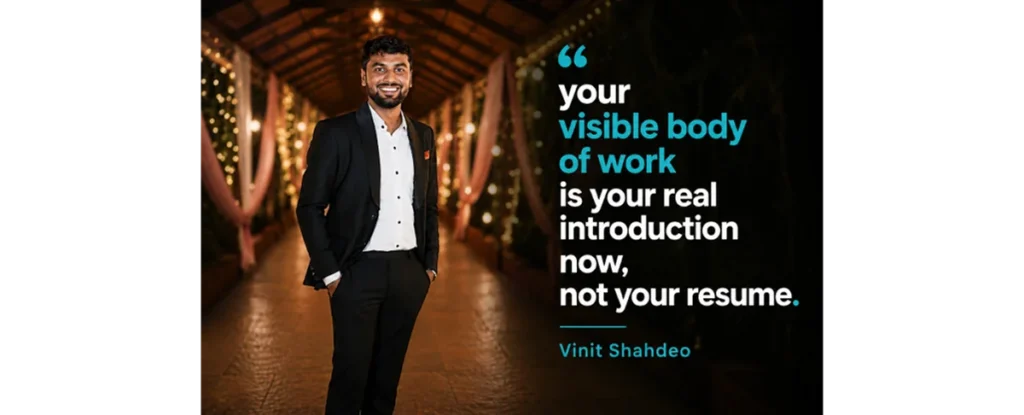
That is the whole idea behind Vinit Shahdeo’s new book, Digital Footprint for Software Engineers. The argument is simple, and it has aged well into the AI era: your visible body of work is your real introduction now, not your resume. The book treats this the way an engineer would, with concrete habits instead of hype. How to build a GitHub profile that signals ownership. How to write about your work without performing. How to stay discoverable without turning your career into a marketing job. None of it is about going viral. It’s about being findable and credible, and building it slowly enough that it’s real.
That last part matters more than it used to. In a market where anyone can produce a great-looking application in minutes, the one thing that still holds is a record that took years to build. AI can write your resume. It can’t write your history. That has to be earned, one repo and one post at a time, and right now it’s the closest thing to job security an engineer has.
Digital Footprint for Software Engineers by Vinit Shahdeo is now available on Amazon.