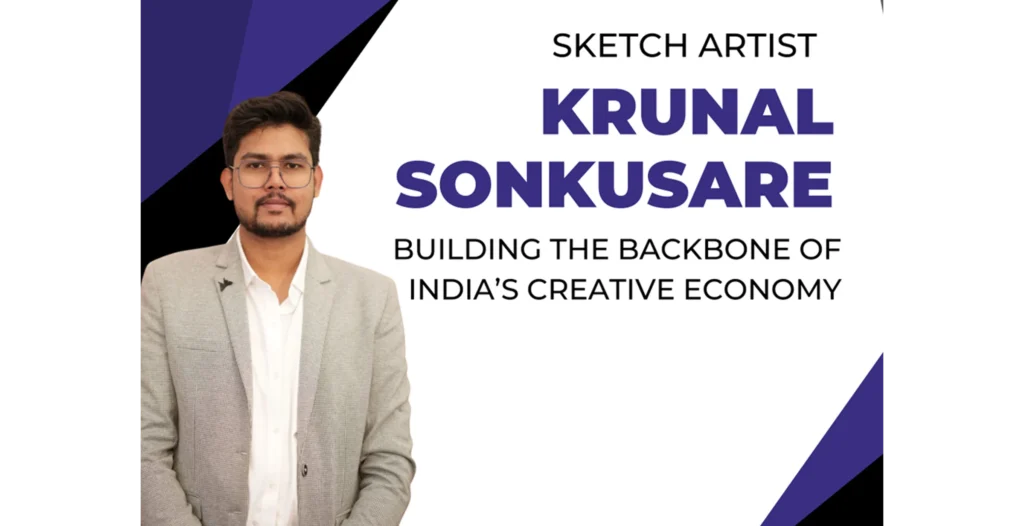
Sketch Artist Krunal Sonkusare: Building the Backbone of India’s Creative Economy
When people speak of India’s economic growth, they often mention manufacturing plants, IT parks, and digital startups. But in a quiet studio in Nagpur, a different kind of enterprise is taking shape, one built on pencils, patience, and purpose.
Meet Krunal Sonkusare, a distinguished Sketch Artist from India who has spent over two decades proving that creativity can be both a profession and a powerful pillar of the nation’s economy.
From Sketchbook to Skill Builder
Krunal’s story began with a single sketchbook and an unshakable belief that art can shape lives. Over time, that belief turned into a movement. Today, he stands as one of India’s most respected portrait drawers and art educators, with more than 500 commissioned artworks and countless students mentored under his guidance.
Through his classes and workshops, Krunal helps students transform raw passion into refined skill. He prepares young artists for India’s Elementary and Intermediate Drawing Examinations crucial stepping stones for those who wish to pursue fine arts professionally. His methods focus on consistency, observation, and precision, blending creativity with discipline.
“An artist’s greatest tool isn’t just the brush or the art pencil for drawing & sketching,” Krunal says. “It’s the ability to sit with an idea until it turns into something beautiful.”
Art as an Economic Force
Globally, the creative economy contributes billions to GDP. In India, it is gradually gaining recognition as a legitimate industry that fuels innovation, culture, and self-employment. Krunal’s work embodies this shift. By establishing a model where art education and entrepreneurship coexist, he is helping turn creativity into commerce.
His students don’t just learn to draw; they learn to build a career. Many have gone on to become freelancers, designers, illustrators, and teachers. By showing them how to monetize their skills ethically and effectively, Krunal is redefining what it means to be an artpreneur, an artist who thinks like an entrepreneur.
The Artpreneur Movement
Krunal coined the term Artpreneur to represent the new-age creator who blends talent with business sense. In his view, an artist should be able to earn from art without compromising authenticity. His workshops teach not only drawing techniques but also presentation, pricing, and client communication, the cornerstones of sustainable creative practice.
Every pencil stroke, every art doodle, every class assignment is part of a larger purpose: to build a structured ecosystem where artistic talent contributes directly to the economy.
He often tells his students, “Art can pay bills if you learn to treat it with the same respect you give any profession.”
Beyond the Pencil: Exploring Mediums and Mindsets
Although Krunal is best known for his hyper-realistic pencil portraits, his creative expression goes far beyond graphite. He often experiments with pen art, where every line demands precision and patience. His pen drawings, marked by clean textures and intricate details, have gained appreciation for their storytelling depth.

He also encourages his students to explore canvas painting and drawing, where colors and emotions meet technique. For him, art education must go beyond a single medium; it should cultivate adaptability. “Whether it’s charcoal, brush, or digital stylus, the medium changes but the mindset remains constant,” he explains.
This open approach allows his learners to transition seamlessly between art forms, expanding their opportunities in fields like animation, interior design, and fashion illustration.
Building Nagpur’s Creative Identity
While most artists migrate to metropolitan hubs, Krunal chose to root his work in Nagpur, turning it into a nucleus for creative education in Central India. His institute has produced dozens of successful artists who now contribute to the local economy, teaching, exhibiting, and collaborating with industries that require visual storytelling.
His decision to stay and build locally is deliberate. “If every artist leaves for a bigger city, smaller cities never grow,” he says. By nurturing homegrown talent, he ensures that the next generation of artists can thrive without leaving their hometowns.
Through community workshops and school collaborations, he has made art accessible to hundreds of children who might otherwise never pick up a pencil. For many, the journey begins with a simple art doodle and often ends in a full-fledged artistic career.
The Soul of a Blood Artist
Among his students, Krunal is affectionately known as a blood artist, someone who pours heart and soul into every line he draws. The term captures his intensity: he sketches for hours, refining each shade until it reflects the emotion he envisions. His students say that watching him work is like watching meditation in motion.
That same passion fuels his mentorship. He pushes learners to pursue excellence, reminding them that great art, like great entrepreneurship, is built on persistence. “You can’t rush mastery,” he tells them. “You must live with your art until it becomes part of you.”
Art Education as Nation Building
Krunal believes India’s next economic leap will come from integrating creative education into the mainstream skill-development narrative. He often highlights how artistic training develops fine motor skills, emotional intelligence, and design thinking traits essential for innovation in any field.

By guiding hundreds of students into art-based professions, he’s quietly helping India strengthen its creative backbone. Every portrait, every sketch, and every classroom session adds to an economy that values imagination as much as industry.
A Vision Beyond the Canvas
As India accelerates toward a knowledge-driven future, Krunal Sonkusare’s work reminds us that creativity is not ornamental; it’s foundational. His journey from a small studio to national recognition represents the evolving role of the Sketch Artist in India from artisan to educator, from teacher to entrepreneur.
In a country bursting with talent, his story stands as a blueprint for how art can create jobs, confidence, and culture.
Through his pencil and his purpose, Krunal Sonkusare isn’t just drawing portraits; he’s drawing possibilities.