Accessibility is not an enhancement to digital experiences. It is the foundation of an experience designed for everyone.
In an increasingly digital-first world, a website is often the primary gateway between an organization and its audience. Yet, when digital experiences are not designed with accessibility in mind, essential information, services, and opportunities can remain inaccessible to people with disabilities.
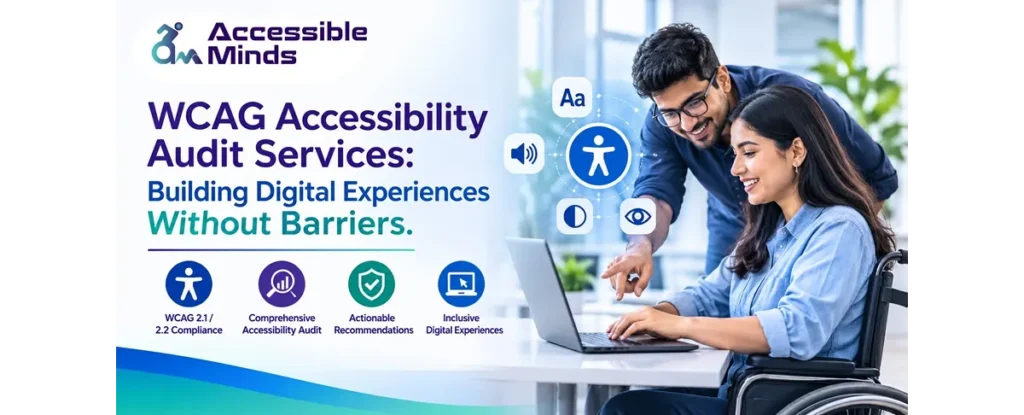
WCAG Accessibility Audit Services provide organizations with a structured approach to identifying digital accessibility barriers, evaluating website experiences against established accessibility principles, and creating a clear roadmap for remediation.
At Accessible Minds, we believe accessibility extends beyond technical compliance. It is about creating digital environments where users can navigate, understand, interact, and accomplish their goals with independence and confidence.
“True digital accessibility begins where assumptions about the user end.”
What Are WCAG Accessibility Audit Services?
WCAG Accessibility Audit Services involve a systematic evaluation of websites, web applications, and digital interfaces against the Web Content Accessibility Guidelines (WCAG).
Developed by the World Wide Web Consortium (W3C), WCAG provides internationally recognized recommendations for making digital content more accessible to people with disabilities.
The framework is built around four fundamental principles:
- Perceivable – Information and user-interface components should be presented in ways users can perceive.
- Operable – Interfaces should be navigable and usable through appropriate input methods.
- Understandable – Content, navigation, and interactions should be clear and predictable.
- Robust – Digital content should work reliably across browsers, platforms, and assistive technologies.
A professional audit does not merely search for technical errors. It examines the complete digital experience to understand how accessibility barriers can affect real users.
Why Does a Website Need a WCAG Accessibility Audit?
Accessibility issues are not always visible to the average website visitor.
A website may appear visually polished while a user navigating with a keyboard cannot reach an essential button. A form may look perfectly functional while its fields remain difficult to interpret through a screen reader. Important information may be communicated through colour alone, creating barriers for users with visual impairments.
A WCAG audit helps organizations uncover these less obvious barriers.
A comprehensive accessibility audit can help identify:
- Keyboard navigation and focus-related barriers
- Screen-reader compatibility issues
- Missing or inappropriate alternative text
- Incorrect heading structures
- Insufficient colour contrast
- Inaccessible forms and error messages
- Improper ARIA implementation
- Unclear links and interactive controls
- Inaccessible menus, dialogs, accordions, and dynamic components
- Navigation and interaction inconsistencies
- Mobile and responsive accessibility concerns
The purpose is not simply to find what is wrong. The purpose is to understand what prevents users from achieving what they came to the website to accomplish.
Website WCAG Accessibility Audit Services in India
India’s digital ecosystem spans financial services, healthcare, education, e-commerce, SaaS, government platforms, enterprise technology, and countless consumer-facing services.
As organizations expand their digital footprint, accessibility becomes an increasingly important component of responsible digital product development.
Website WCAG Accessibility Audit Services in India enable organizations to assess their digital platforms through a structured accessibility framework rather than relying on assumptions, visual inspection, or automated accessibility scores alone.
A mature accessibility strategy considers both technical conformance and human experience.
Organizations can use accessibility audits to:
- Establish a clear accessibility baseline
- Identify barriers across critical user journeys
- Prioritize high-impact accessibility issues
- Provide actionable recommendations to development teams
- Improve website usability and navigability
- Strengthen accessibility governance
- Support organizational accessibility objectives
- Create more inclusive digital products and services
“A website should not merely be accessible in theory. It should be accessible in practice, interaction by interaction.”
Automated Testing vs. Comprehensive Accessibility Auditing
Automated accessibility testing has become an important part of modern digital quality assurance. Automated tools can efficiently scan websites and detect numerous technical accessibility issues.
However, automation cannot evaluate every aspect of the human experience.
Certain accessibility considerations require manual assessment, contextual understanding, and assistive-technology testing.
A comprehensive WCAG accessibility audit can therefore combine:
- Automated accessibility testing for scalable technical detection
- Manual testing for issues requiring human judgement
- Keyboard testing to assess navigation and interaction without a mouse
- Screen-reader testing to evaluate semantic information and announcements
- Visual assessment covering contrast, focus indicators, typography, and interface presentation
- Component testing for forms, menus, modals, buttons, carousels, and other interactive elements
- User-journey analysis to evaluate accessibility across meaningful tasks rather than isolated pages
This multidimensional approach provides a considerably more meaningful picture of a website’s accessibility maturity.
What Does a WCAG Accessibility Audit Evaluate?
A professional accessibility audit should examine the website as an ecosystem rather than treating individual accessibility errors as isolated technical defects.
Key areas of evaluation may include:
1. Semantic Structure
Assessment of headings, landmarks, HTML semantics, lists, tables, and page structure to ensure information can be understood by assistive technologies.
2. Keyboard Accessibility
Evaluation of whether users can access interactive elements, navigate logically, operate controls, and maintain visible focus without relying on a mouse.
3. Screen Reader Compatibility
Assessment of accessible names, roles, states, properties, reading order, announcements, and dynamic content.
4. Visual Accessibility
Review of colour contrast, focus visibility, text presentation, scalable content, and other visual considerations.
5. Forms & Error Handling
Evaluation of labels, instructions, validation, error identification, error messaging, and successful completion of forms.
6. Interactive Components
Testing of buttons, dropdowns, menus, accordions, modals, tabs, sliders, carousels, and other dynamic components.
7. Alternative Text & Non-Text Content
Assessment of whether meaningful images, icons, videos, and other non-text content have appropriate accessible alternatives.
8. Responsive Accessibility
Evaluation of accessibility across different screen sizes, devices, orientations, and interaction methods.
From Audit Findings to an Actionable Accessibility Roadmap
An accessibility audit becomes truly valuable when its findings can be translated into practical action.
A sophisticated audit report should therefore provide more than a list of WCAG violations.
It should help designers, developers, QA teams, product managers, and business stakeholders understand what needs to change and why.
A comprehensive report can include:
- Accessibility issue and description
- Relevant WCAG success criterion
- Conformance level
- Affected page or component
- User impact
- Severity or priority
- Supporting evidence
- Recommended remediation
- Technical guidance for implementation
- Validation and retesting requirements
This creates a structured bridge between accessibility assessment and remediation.
“The measure of a valuable audit is not how many issues it discovers, but how effectively it enables the organization to resolve them.”
Why Accessibility Should Be Part of Digital Quality Assurance
Accessibility should not be treated as a final-stage activity performed immediately before a website launch.
When accessibility considerations are integrated earlier into the product lifecycle, organizations can identify barriers before they become expensive, deeply embedded technical problems.
Embedding accessibility into design, development, testing, and release processes can help organizations establish a more sustainable accessibility culture.
An accessibility-first development mindset can contribute to:
- Better digital usability
- More consistent user experiences
- Reduced accessibility debt
- More inclusive product design
- Improved quality assurance processes
- Greater awareness among product and engineering teams
- More resilient digital experiences
Accessibility therefore becomes more than a compliance exercise—it becomes part of digital product excellence.
How Accessible Minds Approaches WCAG Accessibility Auditing
At Accessible Minds, our approach is centred around a simple principle:
Digital experiences should be engineered for people, not just interfaces.
Our accessibility perspective combines standards-based evaluation with practical consideration of how users interact with digital products.
The focus is on identifying barriers, understanding their impact, and providing meaningful recommendations that teams can translate into implementation.
Our approach emphasizes:
- Standards-driven assessment
- Human-centred accessibility evaluation
- Manual and automated testing methodologies
- Assistive-technology considerations
- Actionable accessibility reporting
- Prioritized remediation guidance
- Continuous accessibility improvement
For organizations looking for Website WCAG Accessibility Audit Services in India, this approach can provide a structured foundation for moving from accessibility awareness toward measurable digital inclusion.
Frequently Asked Questions About WCAG Accessibility Audits
What is a WCAG accessibility audit?
A WCAG accessibility audit is a structured evaluation of a website or digital product against applicable Web Content Accessibility Guidelines to identify accessibility barriers and provide recommendations for remediation.
Is an automated accessibility scan enough?
No. Automated tools can identify many detectable accessibility issues, but they cannot independently assess every aspect of usability, interaction, context, or assistive-technology experience. A comprehensive audit combines automated and manual evaluation.
What WCAG level should a website target?
WCAG defines three conformance levels: Level A, Level AA, and Level AAA. The appropriate target depends on the organization’s requirements, digital product, accessibility objectives, and applicable policies or regulations. Many organizations use Level AA as a practical target.
How often should a website undergo an accessibility audit?
Accessibility should be treated as an ongoing process. Audits can be particularly valuable following major redesigns, website migrations, new product launches, significant feature releases, or substantial changes to critical user journeys.
Can accessibility improvements improve overall user experience?
Yes. Improvements such as clearer navigation, better form structures, meaningful error messages, visible focus states, logical content hierarchy, and predictable interactions can benefit users broadly—not only users with disabilities.
Summary: Accessibility Is the Architecture of Inclusion
A modern digital presence should do more than attract visitors. It should enable people to access information, complete tasks, interact with services, and participate independently.
WCAG Accessibility Audit Services provide organizations with the insight required to identify digital barriers, understand their impact, prioritize remediation, and build more inclusive experiences.
For businesses searching for Website WCAG Accessibility Audit Services in India, the right approach is not to pursue accessibility through automated scores alone. It is to combine standards, technology, manual expertise, assistive-technology testing, human-centred evaluation, and continuous improvement.
At Accessible Minds, we believe accessibility should be embedded into the DNA of digital experiences—not added as an afterthought.